Connect
POS, ERP, CRM, ticketing, email, and files—governed integrations, not one-off scripts.
Retail, services, logistics, manufacturing, professional services
Information about orders, jobs, and cases is scattered across apps and inboxes. Teams copy it by hand, wait on handoffs, and absorb extra cost and quality issues—not because people are slow, but because the work is manual or siloed.
Tealfabric runs that process on your stack—governed AI agents your ops team can delegate to, with human approval and a full record of what happened.
Fewer manual touches. Faster cycle times. Clear ownership from request to done.
Prefer to see it first? Watch the 60-second demo, or start a design partner pilot.
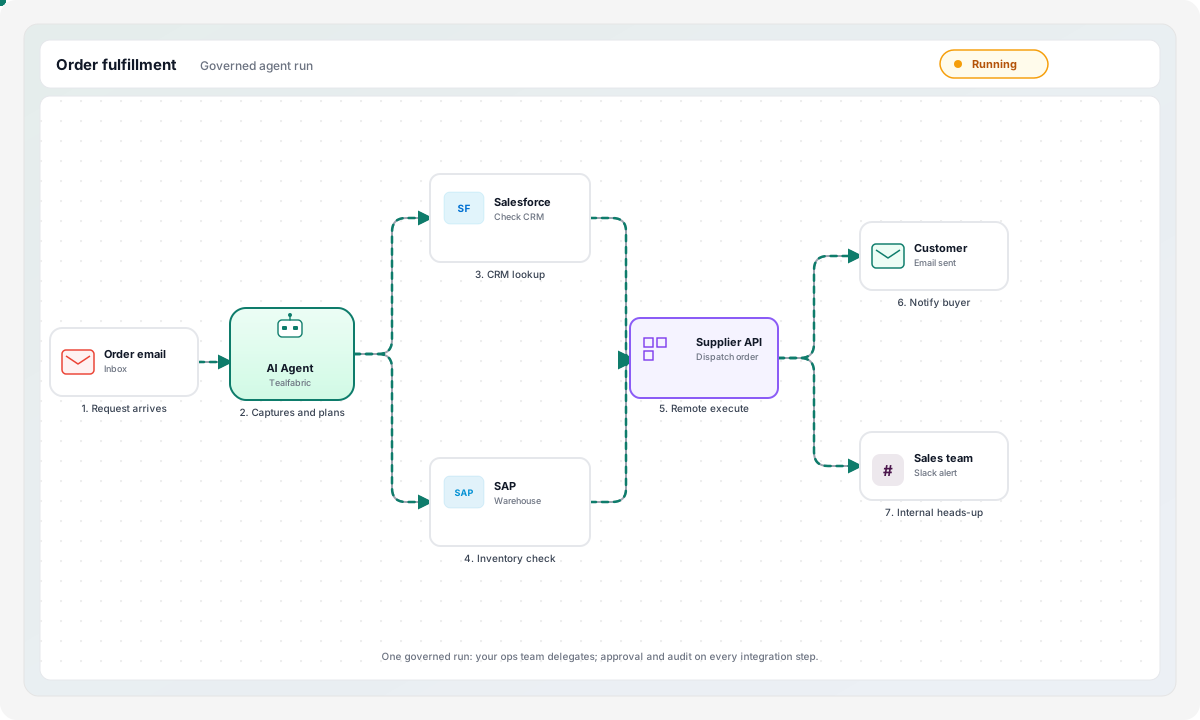
The pattern
Information crosses apps, but execution still lives in inboxes and spreadsheets—manual, siloed, and expensive.
Work can flow again—with your ops team owning the process and delegating steps to governed AI agents.
Three journeys
Production patterns, not fixed bundles. Pick one workflow on your tenant; expand when the first path is trusted.
Less re-keying, better data quality.
One path from web, email, portals, documents, or APIs into CRM, ERP, and ops—with governed agents where policy allows.
Proof: Customer and vendor intake workflow
Outcome: Faster request-to-action time, fewer re-key errors, and auditable lineage from submission to systems of record.
Consistent runs, time back for ops.
Encode handoffs and exceptions once; your team and governed AI agents run the same flow.
Proof: Ops exception handling with human approval
Outcome: More consistent execution, faster exception cycles, and automation your ops team trusts.
Extend the stack you already run.
Governed connectors, orchestration, and AI agents—retries and recovery without rip-and-replace.
Proof: Failed sync detection and retry workflow
Outcome: Fewer replacement pressures, faster recovery when syncs fail, and a controlled path for AI on production integrations.
How it works
Keep your stack. Run the process on one tenant—people, integrations, and governed AI agent teammates on the same records.
Connect
POS, ERP, CRM, ticketing, email, and files—governed integrations, not one-off scripts.
Run
Process flows and WebApps—with AI agent teammates your team delegates to, plus branches and human steps.
Prove
Approval, Monitor, and audit on every run. Retry and recover failures under policy.
Built into every run
People approve what matters. AI agents and automation run only under your policies—with audit history and Monitor when judgment or recovery is needed.
Beyond field sync
iPaaS moves data between apps. You still need ownership, approvals, exceptions, and proof—on the stack you already run.
| Capability | Point-to-point automation | Governed process runtime |
|---|---|---|
| Work stays in existing systems | No | Yes |
| Cross-team handoffs with clear ownership | limited | Yes |
| Intake across forms, email, and APIs | limited | Yes |
| Integrations | Yes | Yes |
| Workflow automation | Yes | Yes |
| Human approvals before execute | limited | Yes |
| Exceptions handled in the same run | rare | Yes |
| AI with policy on tenant data | limited | Yes |
| Full history across the workflow | rare | Yes |
From design partner pilots
Illustrative results from design partner workflows. Outcomes depend on scope and your starting point.
Industrial distribution · EU · Salesforce + NetSuite
Time from request to CRM
2–3 business days → under 4 hours
Illustrative · Design partner pilot window, 2026
Manufacturing · SAP integration · production ops + platform engineering
Time from failure to fix
often 12–24h (inbox) → ~20–30 min
Illustrative · Design partner pilot window, 2026
B2B services · Nordics · multi-entity
Time to resolve exceptions
~2 days → same business day
Illustrative · Design partner pilot window, 2026
“We stopped typing vendor intake from email into Salesforce. One branded form run updates CRM and our ops data store—with a link to the run history when finance asks what happened.”
Request to action, business workflows, or connected systems—your team in charge, governed AI agents to delegate to, approval and audit built in. Book a walkthrough for your stack.